
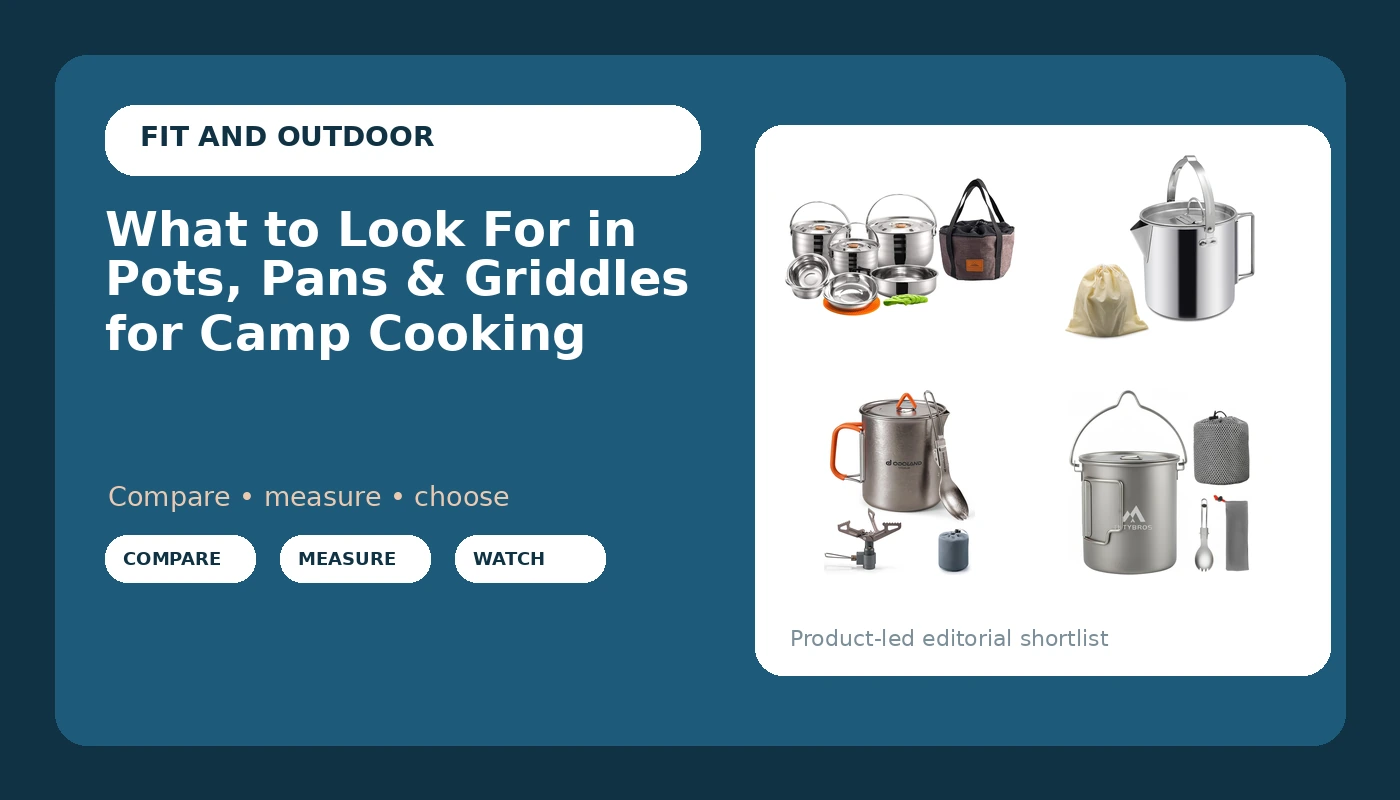
Camp cookware usually gets bought after the stove, in a hurry, on the way out the door. That order is backwards. At the rental and repair counter I worked for a decade on the Cascade lakes, the pots that came back were rarely defective. They were the wrong metal for the burner, the wrong volume for the group, or the wrong shape for the pack. Knowing what to look for in pots, pans & griddles comes down to matching three things: metal to heat source, volume to the number of people, and shape to how you carry it. Everything else is detail. This guide works through those decisions, then looks at four pieces that cover different jobs.
Quick answer
Match the metal to the burner and the volume to the group, then buy the smallest set that still cooks the meals you actually make. For solo trips where you boil water and eat straight from the pot, thin titanium is the light choice. For two to four people cooking real meals, a nesting stainless set earns its extra weight. A kettle only pays off if hot drinks are a daily ritual. A griddle only pays off if flat-surface cooking matters more to you than pack space, and none of the four pieces below is a griddle.
Four useful options
| Model | Best fit | What stands out |
|---|---|---|
| CAMPINGMOON Camping Cookware Set Stainless Steel Outdoor Nesting Cooking Mess Kit Pots Pans Bowls with Storage Carrying Tote Bag | Two to four people cooking full meals | Stainless steel pots, pans and bowls that nest together, plus a carrying tote |
| Camping Tea Kettle, Portable 1.2L Coffee Pot, Silver | Hot drinks for a small group | A dedicated 1.2L kettle with a spout instead of a multi-use pot |
| Odoland Titanium Camping Cookware 750ML Titanium Pot with Camping Stove and Spork Portable Pot for Backpacking, Hiking, Traveling and Picnic | Solo backpackers who want one purchase | Titanium pot bundled with a stove and a spork |
| Titanium Cup Ultralight Camping Mug with Foldable Handle & Lid, Pure Titanium Cookware for Outdoor Hiking, Backpacking, Picnic, and Campfire | Coffee, tea and rehydrating at camp | Titanium mug with a folding handle and a lid |
The group kit: CAMPINGMOON Camping Cookware Set Stainless Steel Outdoor Nesting Cooking Mess Kit Pots Pans Bowls with Storage Carrying Tote Bag
Stainless steel is the pragmatic choice for group cooking, and the trade-off is weight. It takes a scouring pad without complaint, it does not care whether you stir with a metal spoon, and it spreads heat more evenly than the paper-thin titanium pots that weigh less. On a canister stove at 8,000 feet, that evenness matters: a thin pot scorches rice in the centre while the edges are still crunchy. The cost is grams, and for a group kit carried from the truck to the picnic table, that is usually the right trade. Where this kind of set gets awkward is on a long portage or a multi-day pack trip, and where nested kits in general get awkward is noise. Nested metal rattles, so pack a cloth between the pieces or keep the tote snug. Check that the tote actually closes around the stack with the pieces you plan to use, because a bag that almost fits is worse than no bag.
The kettle: Camping Tea Kettle, Portable 1.2L Coffee Pot, Silver
The honest question about any kettle is whether it justifies being a separate object in your pack. Pouring coffee from a saucepan works, badly: the spout is a lid edge, the grounds go everywhere, and you burn your thumb on the rim. If two or more people in your party want a hot drink before the trail, a dedicated kettle stops being a luxury. At 1.2 litres this one covers a handful of mugs in a single boil, which saves fuel compared with three separate small boils. Against it, a kettle is dead weight for the rest of the trip if you only drink water. The other thing to look at is the base: a wide flat base sits steadier on a burner and picks up more flame than a narrow one, and a kettle with a small base on a wide burner wastes heat up the sides. Think of this as the coffee half of a pots, pans & griddles buying guide, because hot drinks are where most camp cookware sets quietly underperform.
The solo pot: Odoland Titanium Camping Cookware 750ML Titanium Pot with Camping Stove and Spork Portable Pot for Backpacking, Hiking, Traveling and Picnic
Titanium is the metal you choose when the pack weight is the constraint and the menu is simple. It is light for its strength, it survives being dropped on granite, and it does not care about being packed wet. What it does not do is spread heat. A thin titanium pot puts a hot ring exactly where the burner flame hits and leaves the rest of the base cooler, so anything thicker than soup needs stirring and a low flame. That is not a defect, it is the nature of the material, and it is why titanium suits boiling water, rehydrating meals and simmering small portions rather than sauteing for four. At 750ml this pot is a solo size, roughly one generous meal or two mugs of water. Bundles always involve a compromise, and here the compromise is the stove: it is the part that decides whether the kit works in wind and cold, so read the burner details and the pot supports rather than the pot. Read pots, pans & griddles reviews for the failures, not for the praise, and the bundled stove is usually where the story is.
The mug: Titanium Cup Ultralight Camping Mug with Foldable Handle & Lid, Pure Titanium Cookware for Outdoor Hiking, Backpacking, Picnic, and Campfire
A mug looks like an afterthought until the second morning, when your coffee tastes of last night's chilli because the only vessel you own is the dinner pot. The lid is the feature worth caring about: a covered mug keeps a drink hot in cold air, and the same lid keeps grit out when the wind picks up. A folding handle matters more than it sounds, because it lets the cup nest against other gear without a rigid loop snagging on everything in the pack. The limit is obvious and worth stating: a mug is not a pot. You can boil a small amount of water in it, but it has no lid seal for real cooking, no wide base, and no volume for a meal. Treat it as the drinking vessel and the backup measure, not the kitchen.
Prices and availability may change. Product images, names, and retailer links must be matched by verified ASIN. Do not state a current price, rating, stock status, or measured result without current evidence.
The short version of what to look for in pots, pans & griddles: metal first
The metal decides almost everything downstream: weight, how evenly food cooks, how the piece survives a season of being scraped and stacked.
Stainless steel is heavy, tough, and forgiving. It handles high heat, metal utensils, and scouring. It heats slowly and unevenly compared with aluminium, and it is the right call for group cooking where durability beats grams.
Aluminium conducts heat well and weighs little, which is why most inexpensive camping sets use it. Bare aluminium dents and can warp when a burner is cranked under an empty pot. Hard-anodised aluminium resists scratching better and is worth the small premium.
Titanium is the lightest option that still takes real abuse. It is a poor heat spreader, so thin titanium scorches in the centre of the base. Buy it for boiling and rehydrating, not for pancakes.
Coatings make cleanup easy and punish abuse. A nonstick pan used with a metal spork and a high flame will shed its coating faster than one used with a plastic utensil and a moderate flame.
Griddles follow their own rules. A flat plate is only as good as its thickness: thin steel flexes and develops hot stripes over the burner, while a heavier plate holds heat through a batch of pancakes. Width matters more than diameter claims, because a griddle wider than your burner leaves cold corners, and a griddle with no lip lets grease run into the stove.
Handles and lids finish the job. Riveted handles outlast spot welds, folding handles save pack space, and a lid is not decoration: it traps heat, which is the cheapest fuel saving available to you.
Size, nesting, and fuel use: how to choose pots, pans & griddles that match your stove
This is the material half of a pots, pans & griddles buying guide; the sizing half is where most people overshoot. A set that is too big for the burner wastes fuel up the sides of the pot, and a set that is too small for the group means two rounds of cooking on one canister. Fuel is part of the decision: pots, pans & griddles fuel use depends on base diameter, lid fit, and how much wind protection you carry.
A practical size guide for pots, pans & griddles starts with volume per person. Around 750ml is a solo boil-and-eat pot. One litre covers a solo eater who wants coffee as well. Two to three litres handles two people cooking a real meal, and group sets climb from there. A 1.2 litre kettle is a hot-drink volume, not a cooking volume.
- Measure the widest compartment of your pack and the inner width of your car camp box; buy cookware that fits one of them without being wedged.
- Match the pot base to the burner head. A base much wider than the flame ring runs cold at the edges; a base much narrower sends flame up the sides.
- Count people and cups separately, because drinks and meals have different volumes.
- Test whether the stove, fuel canister, lighter and spork nest inside the pot with the lid on. If they do not, you are carrying two objects instead of one.
- Check the lid: it should sit flat as a lid and be usable as a shallow pan or plate if the maker intends that.
Beginners make the same mistake repeatedly: they buy a large set with pieces they never use. Pots, pans & griddles for beginners should be minimal, one pot and one mug is a legitimate starting kitchen, and it teaches you what you actually miss before you spend again. Pots, pans & griddles for camping earn their place through repeated use, not through piece count.
Practical guidance before you buy
- Weigh your current setup, including lids and the stuff sack, then compare honestly against the replacement.
- Cook one real meal on your camp stove at home before a trip. Hot spots show up immediately.
- Skip any set with pieces you cannot name a use for; the unused pan becomes pack weight forever.
- Carry a pot grab or folded bandana, since thin metal handles and hot lids do not announce themselves.
- Check that the handles stay cool enough to grip when the pot is full, or plan to use a cloth every time.
- Store fuel and food separately, and never pack a canister loose where a handle can pierce it.
Which option should you choose?
Choose the CAMPINGMOON Camping Cookware Set Stainless Steel Outdoor Nesting Cooking Mess Kit Pots Pans Bowls with Storage Carrying Tote Bag when you cook for two to four people from a base camp or the back of a vehicle and want pots, pans and bowls that pack into one tote. Choose the Camping Tea Kettle, Portable 1.2L Coffee Pot, Silver when hot drinks are a daily ritual and the group is small enough that 1.2 litres covers everyone. Choose the Odoland Titanium Camping Cookware 750ML Titanium Pot with Camping Stove and Spork Portable Pot for Backpacking, Hiking, Traveling and Picnic when you are packing solo, counting grams, and want the stove, pot and utensil settled in one purchase. Choose the Titanium Cup Ultralight Camping Mug with Foldable Handle & Lid, Pure Titanium Cookware for Outdoor Hiking, Backpacking, Picnic, and Campfire when you already have a pot and want a light, lidded cup that keeps coffee out of your dinner.
One caveat on evidence. Nothing here is a measurement of these four products, and a top rated pots, pans & griddles list will tell you what other shoppers liked rather than whether a handle survives a second season. Judge the metal, the base width, the lid fit and the nesting, because those are the things you can verify before you buy.
The bottom line
Buy cookware for the meals you actually cook, not the ones you imagine. Stainless steel earns its weight for groups and car camping, where durability and even heat matter more than grams. Titanium earns its price for solo trips built around boiling water and rehydrating, as long as you accept hot spots and stir accordingly. A kettle and a lidded mug are small luxuries that pay off daily if you drink coffee or tea outdoors, and dead weight if you do not. Before you commit, measure your pack, count your people, check the base against your burner, and confirm that the lid, the handle and the tote all do their jobs. Knowing what to look for in pots, pans & griddles is mostly refusing to buy pieces you will not use.