Most people learn how to pack dumbbells the expensive way: one 45-pound head through the bottom of a cardboard box, down a flight of stairs, and into the corner of a door frame. The box was never the problem. The assumption was, that a box that survived a printer would survive a plate.
The second lesson costs more. Cast iron does not deform, so every bit of energy you put into a bad load goes into whatever is holding it: the tape, the crate handle, the tailgate, your lower back. I have watched a plastic tote rated for 40 pounds fail at the lid seam with 90 pounds of plates in it, six feet from the truck.
What follows is the sequence I use now. Weigh it, sort it, wrap it, box it, load it low and forward, tie it down, protect both floors, and stage the far end before you lift a single plate. It costs an extra 40 minutes and it saves the two hours you would spend repairing a stair tread.
Why you should trust me
I spent ten years behind the rental and repair counter of an outdoor shop on the Cascade lakes, then five seasons guiding multi-day trips. That means I have moved other people's heavy gear for a living and then moved it again when the weather turned. A guiding truck is a packing problem with a deadline: boats on the roof, food in the middle, and a couple hundred pounds of camp iron that has to ride over the axle or the rear springs tell you about it at the first washboard.
I lift four mornings a week and I have hauled the same cast iron through two moves, one of them into a garage with a lip I had measured wrong. I am not a competitive lifter and I am not going to pretend a plate set is complicated. It is heavy, it is unforgiving, and it is completely predictable if you do the arithmetic before you pick it up.
What I do not do is review gear I have never handled. Where I have not lived with a product, I say so and I stick to what the listing actually claims.
How I picked and how I tested
Neither of the sets below lives in my garage, so I am not going to write a paragraph about how the knurling felt in my hand. What I did was read both listings line by line and compare them against the cast iron I do own, which has survived two moves and a decade of being set down on a rubber mat. For a packing article the questions are narrow: how many pieces are you handling, what shape are they, does the set arrive as one crate or six boxes, and does anything in it roll.
The dumbbells buying guide side of this site covers how to pick weights for your strength level. This piece is about the physical job of moving them. I read specifications, I read buyer comments for the things that break in transit (split crates, missing collars, bent rack legs), and I thought about the consumables you need either way.
Four things decided the picks.
Piece count and weight. A 105-pound set is a manageable number of plates. A racked set in the heavier configurations is a small freight job, and that difference changes your tool list: a blanket and two arms, or a hand truck, straps, and a friend who owes you a favor.
Shape. Hex heads do not roll. Round plates do, and a round plate in a truck bed is a 45-pound puck looking for the one downhill line it can find under braking.
Container. Rubber-coated heads survive contact with each other. Iron plates and a barbell sleeve do not, and the wrap you use is the only thing standing between a plate edge and a knurl.
The reinstall. A set with a rack gives you a destination. The rack footprint tells you where the floor needs protecting and how much room you need before anything comes off the truck.
I also read the dumbbells reviews that were written after a year rather than after a weekend, because the complaints that matter in a move are the ones about hardware, paint, and packaging rather than about how a set looked on day one.
Two ways to pack dumbbells: loose plates or a racked set
The two sets below are not really competitors. One is a plate and barbell set that packs flat and moves like a stack of books. The other is a racked dumbbell set that moves like furniture. Both are legitimate dumbbells home gym builds, and both change how you plan the trip.
Budget pick: US Weight 105 Pound Weight Set with Barbell – Home Gym Workout Equipment
Budget pick
US Weight 105 Pound Weight Set with Barbell – Home Gym Workout Equipment
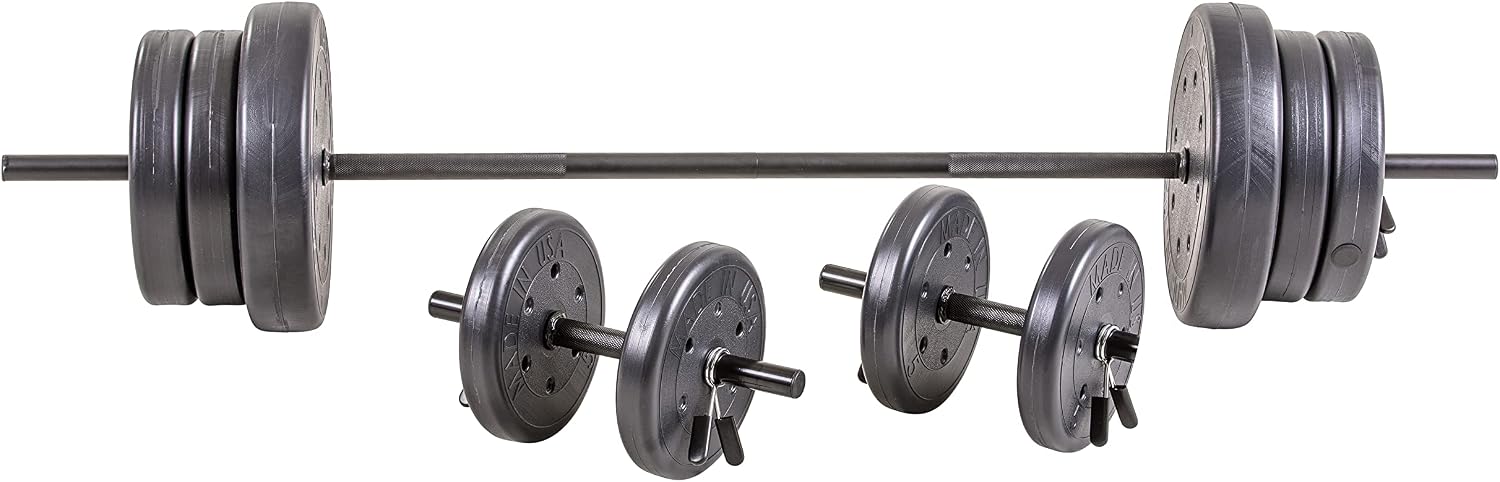
This is the set I would point at if you are building a first home gym in a rental and you know you will move again inside three years. It is 105 pounds of plates and a barbell, which in packing terms means a stack of flat heavy circles and one long awkward item. Flat circles are the easiest heavy thing in the world to move: they stack, they strap, and they do not care which way up they travel.
The barbell is the part people get wrong. Do not lay it diagonally across a load where a plate can land on it, and do not let it ride on top of anything. It goes along the floor of the vehicle, strapped at two points, with the collars in a bag taped to the bar so they do not end up loose in the bottom of a tote.
Check current Amazon price. Whatever it says today, it is the smaller outlay of the two sets here by a wide margin, and the packing materials cost almost nothing: one roll of tape, two old towels, and a double-wall box you were going to recycle anyway.
Flaws but not dealbreakers: Plates and a bar are the two things in a move that will mark a floor, a door frame, or the paint on a tailgate. Budget for a mat at the destination or you will be touching up a wall.
Upgrade pick: Rubber Hex Dumbbell Set with Rack, 8/10/12/15/20 Pair (450/550/780/1200/1550/2100 lbs total) Weight Rack with Dumbbells for Home Gym & Strength Training
Upgrade pick
Rubber Hex Dumbbell Set with Rack, 8/10/12/15/20 Pair (450/550/780/1200/1550/2100 lbs total) Weight Rack with Dumbbells for Home Gym & Strength Training
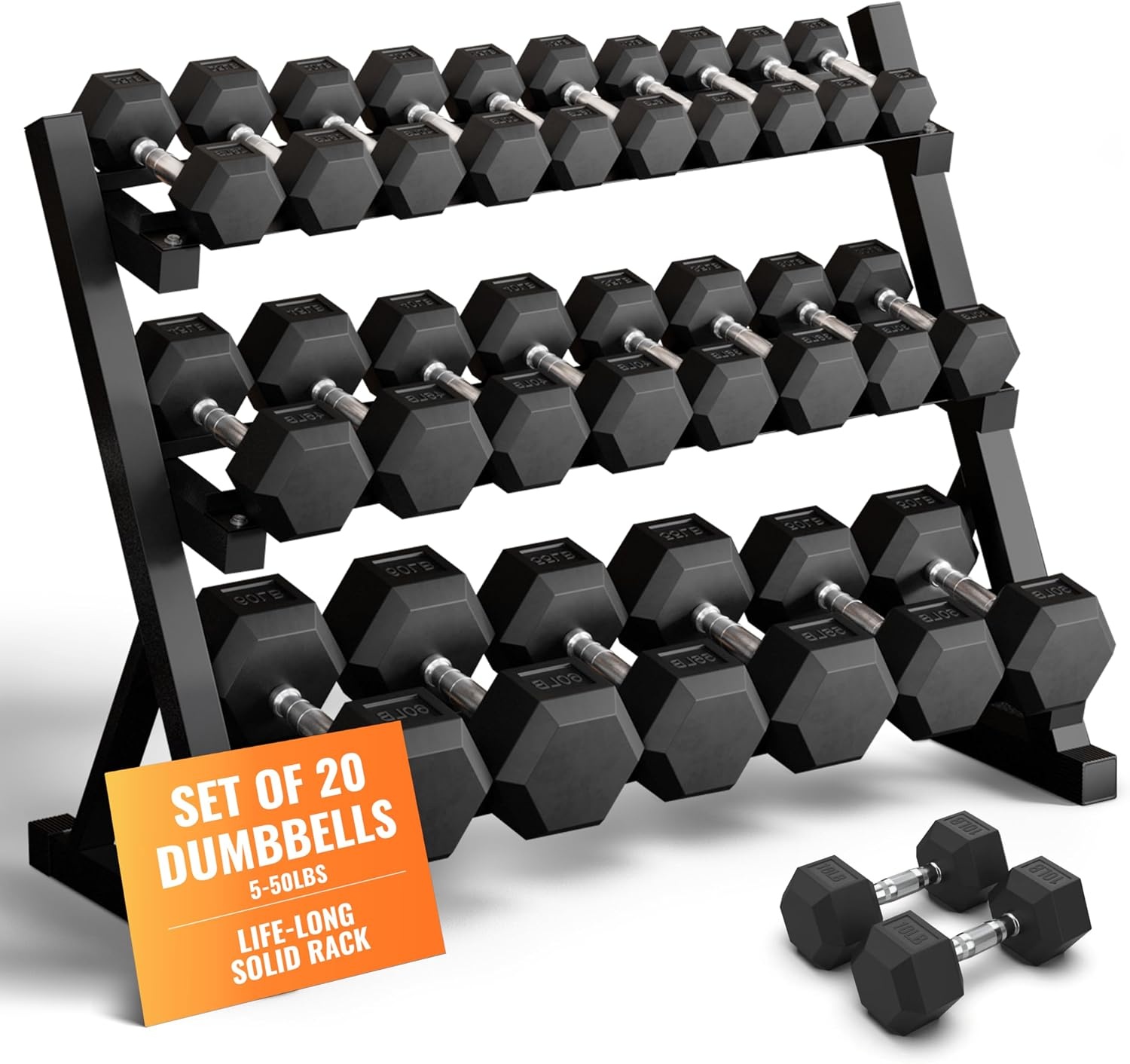
This is the set that turns a move into a logistics exercise. You are buying pairs of rubber hex dumbbells in configurations built around 8, 10, 12, 15, and 20 pound pairs, plus the rack they sit on. At the top end the total weight is measured in the thousands of pounds, which is no longer something you and a friend handle in an afternoon. That is a pallet, a lift gate, and a plan.
The rubber is why this set is easier to pack per pound than bare iron. Hex heads do not roll, the coating does not chip a floor when you set a dumbbell down, and rubber against rubber is a contact you do not have to wrap. The rack is the opposite. Rack legs arrive with paint and with edges, and a blanket between the rack and the dumbbells is the difference between a scratch and a gouge.
Two practical notes from the listing and the buyer comments. First, a racked set ships in more than one box, and those boxes are heavy enough that nobody in the chain will be gentle. Open every box inside the return window and check the rack joints and the leg ends before you flatten the packaging. Second, the pairs have to go back on the rack in order when you rebuild it, so photograph the rack loaded before you take it apart. It sounds fussy. It saves ten minutes of guessing at the far end, and it is the closest thing a dumbbells size guide gets to useful advice on moving day.
Check current Amazon price before you commit, and measure the floor space the rack needs first.
Flaws but not dealbreakers: In the heavier configurations this is not a one-person job at any stage, loading or unloading, and the rack footprint is bigger than most people picture when they order.
The actual packing workflow
None of this requires a gym. It requires tape, a blanket, a marker, and the willingness to make two trips instead of one.
Step one: Weigh and count everything before you touch a box. Write the number down. Count plates, dumbbell heads, collars, and rack hardware on separate lines. You need the total to decide how many loads, and the count to know whether something is missing at the far end. A 45-pound plate is easy to leave in a garage corner because it looks like part of the floor.
Step two: Sort by what you can carry alone. This is the step that decides how to pack dumbbells more than any other. Anything over about 50 pounds does not go into a box you plan to carry by the flaps. Plates go in a plastic tote with a lid, or in a double-wall box with the bottom taped in both directions and reinforced with a folded strip of cardboard. Never a milk crate. Never a grocery bag. Never a cardboard box that has already survived one move.
Step three: Wrap each piece so nothing touches metal. A towel, a cut-up cardboard sleeve, or a foam pad, taped so the wrap cannot unwind in the truck. Rubber hex heads travel fine with a single layer. Iron plates and a barbell sleeve want two, because their edges are what mark everything else in the load.
Step four: Build each box from the bottom up. Heaviest piece flat on the bottom, smaller pieces in the gaps, nothing left loose to shift. Fill the dead space with crumpled paper or a folded blanket so the load cannot move inside the box, because movement is what splits tape. Tape the lid, then run tape around the middle in both directions. Write the weight on the side with the marker so the person helping you knows what they are picking up.
Step five: Treat the barbell as its own item. It does not go in a box. Collars come off and go into a bag taped to the bar, the bar rides along the floor of the vehicle, and it gets strapped at two points. If you break it down, keep the hardware in the same bag as the collars, because a bar without collars is a bar you cannot use.
Step six: Load low, forward, and over the axle. Heavy things go on the floor of the cargo area, ahead of the rear axle or directly over it. Nothing heavy goes on a seat or in a trunk well behind the axle. Strap the load so it cannot slide forward under braking. Then check your tire pressure, because several hundred pounds of iron changes what the sidewall should be doing, and drive like the truck is loaded, because it is.
Step seven: Protect both floors. At the loading end, a blanket on the stairs and a dolly with rubber wheels. At the destination, clear the path before the first plate comes in and put a mat down where the rack or the plate stack will live. Drag nothing. A hex head set down gently on hardwood is fine; a hex head that slides six inches is a repair bill.
Step eight: Stage, assemble, then lift. Put every piece where it will live before you assemble anything. Build the rack first, load the heaviest pairs on the bottom, rebuild the set, and check every collar and connection. Then do one light session, not a heavy one. You will find the loose bolt in the rack, or the plate you left in the garage, at 20 percent effort instead of at the bottom of a squat.
That is the dumbbells setup done properly, and it is a hell of a lot easier than the version where you find out about the loose bolt mid-set.
The competition and why it lost
Adjustable dumbbells with a dial or a selectorized base are the obvious alternative, and for a lot of apartments they are the right answer: one set replaces six pairs and moves in two hands. They lost here for a specific reason, which is that the mechanism is the part that does not enjoy being bounced around a truck bed. A racked hex set has no selector to knock out of alignment.
Vinyl-coated concrete sets are what most people buy first, and they are fine until the coating splits and the fill starts to crumble. They are also the set most likely to arrive with a bent handle, because the handle is a thin tube inside a heavy box.
Plate-loaded handles, where you slide plates onto a short bar and pin them, are the cheapest route to a range of dumbbell weights, and they pack beautifully because they are just plates and hardware. They also take longer to change between sets, which is the trade you make.
Kettlebells are a different tool and they do not stack, which makes them a poor fit for a corner of a small room.
The top rated dumbbells in a listing are not automatically the ones that survive a move intact. The two sets above are in this article because they answer the packing question cleanly: one moves flat, one moves as furniture, and everything else in the category is a variation on those two shapes. If your space is tight, our notes on small-space home gyms are the better starting point.
What this all costs
Two costs, and only one of them is the equipment.
The first is the set. The plate and barbell set is the small outlay, the racked hex set is the large one, and at the top configurations it is a purchase you plan for rather than click at midnight. Both listings move around, so check current Amazon price rather than trusting a number in a post written weeks ago.
The second is the move, and it is cheaper than people expect if you buy the right things once: a roll of decent tape, a pack of moving blankets or two old towels you were going to throw out, a hand truck if you have stairs, and a rubber mat for the destination floor. The mat is the cheapest insurance in the whole job. It is the difference between a floor that survives a dropped 20-pound dumbbell and a floor that does not.
The number that actually matters is time. Packed properly, a 105-pound set is one trip and about 40 minutes at each end. A racked set in a heavy configuration is half a day, two people, and a vehicle you are willing to load to the axle. Packed badly, either one is an afternoon of cleanup and a run to the hardware store for a stair tread. Dumbbells for beginners are not the problem, and neither is the iron itself. The problem is always the container and the plan, so do the weighing, wrap the pieces, make two trips if the load is close, and stage the far end before you lift. That is the whole job.